
A ceramic coating that has stopped beading has not necessarily failed. Traffic film, mineral deposits and product residue can change the way water behaves on the surface. The water-repellent top layer may also have worn down while some underlying protection remains. Start with a careful, coating-compatible wash, rinse thoroughly and assess the surface before adding a booster or deciding to recoat.
This guide helps you work out what to check next. You do not need to buy a replacement coating simply because rain no longer forms the beads you remember.
Real example: a clogged coating before and after cleaning
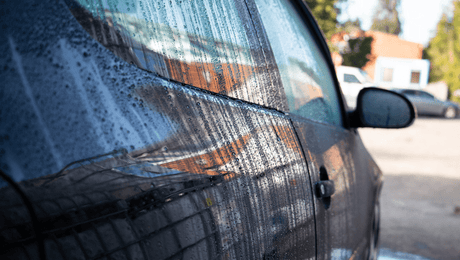
These photographs show how we restored water beading on the same car by washing it with AutoGlanz Power Wash. We used Power Wash to lift the contamination masking the existing coating. The improvement came from cleaning the surface, with no fresh coating applied.


Notice the larger, irregular droplets before washing and the smaller, more even beads afterwards. This shows why we recommend cleaning a poorly beading coating before deciding it needs replacing. For a useful comparison on your own car, check the same panel with a similar water flow before and after washing.
Give a clogged coating a thorough clean with Power Wash. Our alkaline shampoo tackles stubborn road grime and traffic film that can mask water repellency, helping reveal the coating beneath. Use it when your car needs a deeper clean, following our dilution and application instructions. Work on cool panels, rinse thoroughly and never allow the shampoo to dry. Stronger dilutions can affect existing protection, so choose the dilution for the level of soiling and check your coating’s care requirements. If you need help choosing the right wash routine, ask our team.
Does no water beading mean a ceramic coating has failed?
No. Beading describes water gathering into droplets; sheeting describes water flowing off in a film. Both are affected by the surface the water meets. Contamination, recent products and the way water is applied can all influence what you see.
A beading test is useful for tracking changes, but it does not measure coating thickness or prove how much protection remains. Equally, strong beading after applying a topper does not prove that the original coating underneath is healthy: you may be observing the topper.
Some coating systems use a base coating and a separate hydrophobic top layer. Their service lives can differ. That does not mean every coating has the same construction, or that an old base coating must still be present. Check which product was applied and its maintenance instructions.
Why can a ceramic coating stop beading?
Road grime and traffic film cover the surface
A coated car still gets dirty. Oily road film and other contamination can remain after a quick rinse or an incomplete wash. If lower doors and the rear of the car behave differently from cleaner areas, contamination is one possibility worth checking. The pattern is a clue, not a diagnosis.
Hard-water minerals and other bonded deposits build up
Water left to dry can leave mineral deposits. A routine maintenance shampoo may not remove every deposit, even when the car looks clean. Visible water spots may be deposits, etching or a combination; repeatedly scrubbing them is not a reliable way to tell the difference.
Shampoo residue, wax or a drying aid changes water behaviour
Incomplete rinsing can affect the surface you are assessing. Wash-and-wax shampoos, quick detailers and other finishing products may also leave their own layer behind. A recent change in washing products is therefore useful information when investigating a sudden change in beading.
The coating or its maintenance layer has worn
Coatings do not all last for the same period. Exposure, mileage, washing, abrasion and the original application affect their condition. Wear is possible, especially when the correct cleaning process does not improve performance. A durability claim is not a guarantee that every panel will behave identically throughout that period.
The coating is newly applied or its history is unclear
If it has just been applied, follow the specified curing and first-wash instructions. Do not keep wetting or chemically treating a fresh coating to test it. If you bought the car already coated, establish what was applied, when and whether any maintenance products have been used.
How to check a coating that has stopped beading
1. Record what has changed
Note the coating name, approximate application date, last wash and any new products used. Photograph the affected panels and record whether the change is localised or widespread. This gives you something useful to compare, and helps an installer advise you without guesswork.
2. Carry out a careful maintenance wash
Work on cool panels, away from direct sun, and use products compatible with the coating. Clean wheels with separate tools, pre-wash the bodywork, rinse, then contact-wash with clean wash media. Follow the cleaner's dilution and dwell instructions, and do not let it dry.
For the full method, see how to wash a ceramic-coated car. In cold weather, use our winter wash guide alongside the product instructions.
For routine maintenance, we recommend a shampoo without added wax or gloss enhancers so you can assess the clean coating without introducing another finishing layer. AutoGlanz Pure is our pH-neutral, residue-free maintenance shampoo for protected vehicles, making it a straightforward choice for regular washes.
3. Rinse thoroughly and assess before adding protection
Remove the washing solution completely. Observe how clean water behaves on the affected area before using a drying aid, wax or coating booster. Compare the same panel under similar conditions rather than comparing a pressure-washer spray with yesterday's rain.
Then dry the car with clean, suitable towels or a blower. Do not leave water to dry just to watch the beads. If performance improves after washing, contamination or residue was likely contributing; that result still does not establish the coating's remaining lifespan.
4. Treat remaining contamination only when needed
If a proper wash does not help, identify the likely deposit before choosing a treatment. Mineral deposits, iron fallout and tar require different approaches. There is no single cleaner that should automatically be used on every coated car.
- Check compatibility: use a treatment approved for the coating and the vehicle surface.
- Follow its instructions: dilution, temperature, dwell time and rinsing requirements matter. pH alone is not a complete compatibility test.
- Keep treatments separate: do not mix chemicals, increase strength or extend dwell time in an attempt to force a result.
- Stop if uncertain: ask the coating supplier or installer before using an unfamiliar treatment, particularly on repaired paint, matte finishes or wrapped panels.
Our decontamination guide explains different contamination types. It also discusses preparation and mechanical methods; a full preparation process is not automatically appropriate for maintaining an existing coating.
5. Ask for an assessment if the problem remains
If cleaning does not improve the surface, or you see persistent staining, patchy behaviour or damage, send our team photos and details of the products used. We can help you work through the cleaning and maintenance options. If your coating has a warranty, check its maintenance conditions before correction work.
The next step might be specialist cleaning, maintenance of a top layer or replacement protection. Choose it from the evidence and the coating's instructions, rather than using beading alone to decide.
Should you apply a ceramic topper to restore beading?
A compatible topper can maintain water repellency on a clean surface. It cannot remove contamination, repair damaged paint or demonstrate that an underlying coating is still intact. If you are investigating a problem, assess the freshly washed surface first so you know what changed.
For our P Lite coatings, SP1 Ceramic Top Coat is the dedicated maintenance option. Our recommendation is to apply it ideally after every wash, or at least every other wash, following its application instructions. Base the interval on your washing routine rather than a fixed number of months.
Apply SP1 to a clean surface using our application instructions. If you are unsure which AutoGlanz maintenance products suit your coating, contact our team with its name and your current wash routine so we can help you choose the next step.
What to avoid when beading disappears
- Automatically claying or polishing: mechanical treatment can mar the finish or affect the coating. It is not the first maintenance step.
- Using stronger chemicals without a reason: select the treatment for the contamination and coating, not simply the strongest cleaner available.
- Adding a booster before checking the clean surface: this makes it harder to distinguish cleaning results from the booster's effect.
- Assuming water spots prove failure: coated vehicles can still develop spots, and removing a deposit is different from correcting etching.
Common questions about ceramic coating beading
Can a ceramic coating be contaminated but still present?
Yes. Deposits can sit over a coating and change its water behaviour. Suitable cleaning may improve performance, but the result does not tell you precisely how much coating remains.
Will normal shampoo bring the beading back?
It may help when loose grime or residue is responsible. Bonded contamination can require a suitable specialist treatment. Start with a correct maintenance wash before escalating.
Is sheeting better than beading?
Neither observation alone gives a complete verdict on protection. Consider how the surface changes after cleaning and what the coating manufacturer says to expect. A different panel angle or water flow can also change the result.
Should I recoat the car straight away?
No. Establish its history, wash correctly and investigate contamination first. If the coating still performs poorly, seek an assessment before paying for removal and reapplication.
What if I do not know which coating is on my car?
Ask the previous owner or installer for the product name and application record. Use a suitable routine wash while you investigate, and avoid speculative chemical or abrasive treatments.
Need help choosing the next step?
Contact AutoGlanz with the coating name, application date if known, recent washing products and photos of the affected areas. That information is more useful than buying another coating on the strength of a single water test.